![]()
|
|||
![]() |
|||
Quick Links
|
|||
![]() |
I have been marketing a mineral made specifically for wild whitetail deer for 9 years with the best surveillance system available for monitoring mineral licks. Most of my customers have trail camera, which means there is a motion activated camera on thousands of licks made with my mineral 24/7. Any thing that moves gets photographed day or night with flash or infrared. These customers send me their best pictures for bragging rights and I love to get them and use them in all of my literature and online marketing. Included in these submitted photos are impressive pictures of large numbers of deer crowded around a mineral site. If I could get a picture of 20 or 15 deer crowded around one of my mineral licks, I would use it in every piece of literature I have to show everyone. It would be yet another way to prove how well the deer like my mineral. In 9 years and tens of thousands of pictures I have never gotten one of those. The most deer I have ever gotten in any one picture is 5 antlered bucks and another of 3 does with their fawns. |
|
The way deer feed at a mineral source is much different than how they respond to a food source. With a foot of snow or a really dry spell in the summer food is difficult to find and this can create a feeding frenzy. There will often be dozens of deer in the pile at one time fighting for food with lots of contact and often defecation and urination in the food source. Deer could literally be dying of starvation when they walk by a mineral lick and not consume any more of the mineral. If you and your family go without eating for a few days and then are offered a bowl of apples, there would be a feeding frenzy around the apples. If you were offered a bowl of salt and minerals, what would your response be? Pictured left is a typical mineral lick. I have been sent thousands of these pictures and have never seen signs of deer urinating or defecating in the site.
Although there is more traffic at a mineral lick than a random spot in the wild, it is far less traffic than at a food source and there is very little actual contact between the animals. This greatly reduces the risk of transmitting disease from one to another.
Deer have a strong desire to find mineral and will travel for it. The congregating that occurs on mineral licks will be more intense with fewer mineral licks available due to a ban. With a shortage of mineral licks, deer will come to industrial sites, water softener discharges, and agricultural sources such as pasture cattle blocks. With less sites, deer will travel farther and increase the slight risk of disease transmission. If just a fraction of the hundreds of thousands of hunters in the state of Michigan put out mineral sites there would be more sources of better mineral aimed at improved health and as a result there would be less mixing of different groups of deer in an area.
For more research on the subject of disease transmission over mineral licks visit http://www.esri.com/news/arcnews/summer07articles/mineral-licks.html
And now let's discuss the benefits of feeding mineral for the health of the deer and a stronger immune system. There are many different aspects of minerals that can benefit a deer populations health. Although there have been some theories on the relevance of copper and manganese with CWD, I have never found any data that proves this. With my previous experience as a dairy nutritionist, I have found that one of the most important parts of Lucky Buck Mineral is selenium. This is especially true in most mid western states that have a selenium deficiency in the soil. Most of my nutritionist colleagues also acknowledge the deficiency of selenium in Michigan.
Take a look at the following studies:
Muscle Selenium Concentrations in Michigan Deer
http://www.jstor.org/pss/3807941
Key information includes:
- A .25 ppm of selenium in a deer's skeletal muscle tissue is considered deficient. The results of the test in this study show that of 109 deer tested the mean selenium level in Michigan deer is .16 ppm
Selenium deficiency in deer: the effect of a declining selenium cycle?
http://www.deerlab.org/Publ/pdfs/26.pdf
Key information includes:
- Factors that cause selenium deficiency in deer include soil acidification, soil contamination with heavy metals, fertilizer effect, plant community composition, and rate of biomass removal and fire.
- "It is important to note that underlying biochemical lesions of most diseases are ultimately caused by toxic oxygen species. Proper cycling of Se through the soil-plant-animal system is essential to protect animals from oxidant stress."
There are loads of data supporting the relationship between supplementing Se and helping the immune system in species including humans. One example is HIV. According to research by the University of Miami, taking a selenium supplement daily appears to keep HIV at bay by strengthening the immune system.
Selenium and Health: HIV and Africa
http://hms.alltech.com/africablog/immune_system.cfm
Selenium, taken daily, found to keep HIV under control and boost immune system function
http://www.naturalnews.com/021512.html
Key information includes:
- The target cell of HIV is the CD4 cell, which depresses T-cell numbers.
- Selenium deficiency reduces T-cell and overall immune system function.
- HIV robs the host of available selenium for its own purposes.
- Selenium may slow viral replication.
For more specific diseases targeting deer, let's look at Epizootic Hemorrhagic Disease (EHD).
Epizootic Hemorrhagic Disease (EHD) Prevalent During Drought
http://www.sweetlix.com/media/documents/articles/Deer_EpizooticHemorrhagicDiseasePrevalent%20Drought.pdf
Key information includes:
- "Confirmed cases have already been reported in Alabama, Indiana, Kentucky, North Carolina, Ohio, Pennsylvania, Tennessee, Virginia and West Virginia for 2007. Because deer that survive are immune for life, enhancing a herd's immune status through nutritional supplementation is a smart wildlife management tool to help herds not only survive but to also thrive."
- "An outbreak of EHD can kill up to 25% of the total herd."
- "Because EHD is endemic, we cannot prevent outbreaks of EHD. However, through proper nutritional supplementation, we can give deer the building blocks needed to mount a successful immune response, thus improving their odds of survival."
- "There is no question that well-nourished deer are healthier and better able to cope with disease challenges than poorly nourished deer."
- "Additionally, several micronutrients such as selenium, vitamin A, vitamin E, copper and zinc have been shown to play important roles in immune response."
Selenium in the Immune System
http://jn.nutrition.org/cgi/content/full/133/5/1457S
Key information includes:
- ...there is much potential for selenium to influence the immune system."
- ...selenium is essential for the efficient and effective operation of many aspects of the immune system in both animals and humans."
Selenium Related Disorders in Washington Livestock
http://cru.cahe.wsu.edu/CEPublications/eb1607/eb1607.html
Key information includes:
- Selenium is an essential mineral for growth, reproduction, and disease prevention in all animals...It is important that livestock producers in the Northwest understand the effects of selenium deficiency in farm animals. Severe selenium deficiency frequently causes significant sickness and death loss in livestock."
Every decision is made based on risk or cost versus reward or benefit. There is a small risk that a mineral lick could cause the spread of diseases such as CWD due to animals being at one location more often than a random place. The benefit for reducing the severity of CWD or other disease outbreaks by having a stronger immune system is a huge benefit.
Please consider these arguments when forming your opinion for or against the inclusion of mineral (specifically Lucky Buck) in any feeding or baiting ban.
What Lucky Buck Does, and How!
So you dream of going after a giant whitetail? Thinking of scouting him, getting trail camera pictures, maybe even catching him on video some evening and then eagerly anticipating the opening day? Wake up! You can do all this and it is within your budget. With Lucky Buck Mineral for an average of $100 you can run a site for one year and have a gurantee of much larger racks.
Perhaps one of the biggest myths involving whitetails is that you can't make a difference on the size of their antlers. You don't have enough land, too much hunting pressure, poor soil or my favorite, we don't have the genetics!
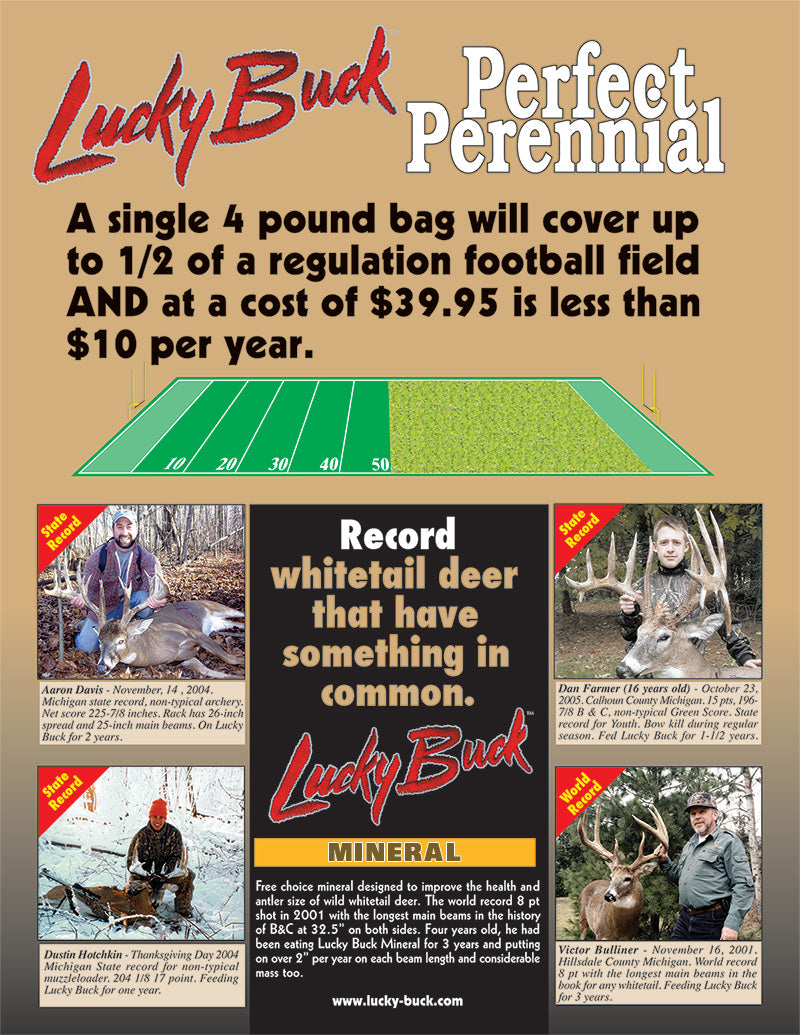
So you don't have a 3,000 acre spread and it doesn't look like you are going to have the cash to buy one real soon? Don't give up. Look at what Dan Farmer did in Southern Michigan in 2005. He managed his property for two years before cashing in on this beauty green scoring 197" and he got it with a bow during regular season at the age of 16. Dan fed Lucky Buck Mineral for almost two years right there. That was on a 10 acre parcel of land. Take the Buliner Buck for another example. He was taken on a farm of 56 acres; he was on Lucky Buck for 3 years. This great 8 point scores 185: and has 32.5: beams. That's the longest ever and wasn't even grown up yet, he was only 4 years old. He would have been impressive in another year or two. At the rate he had grown in the last two years he likely would have been approaching 200" and 35" beams the next year. Again on 56 acres.
Now these bucks are not fenced and they will not stay on these small acreages, but having small acreages makes it even more important to have a reason for them to stick around or stop by for a visit and the best reason is Lucky Buck Mineral.
So you don't have the genetics for these bucks? Take the Aaron Davis buck for example. In all the years that records have been kept wouldn't his "genetics" have come through sometime in the past? The Davis buck scores 225 & 7/8" and has a broken tine that would have likely put him pushing 235". He was harvested in Hillsdale Co. Michigan with a bow and is the new state record for non-typical archery! Hillsdale Co. has never before produced a 200 inch buck. The biggest previously was 191".
By now you may have made the connection that both the Davis buck and the Bulliner buck came from Hillsdale Co. Take a look; do these two racks look like they came from close relatives when you look at the characteristics such as number of points and shape? What they did have in common was Lucky Buck Mineral.
So the hunting pressure is too heavy in your area to get a buck like these? There is no area in the country that has a heavier hunting pressure than the southern tier of counties in Michigan and the northern edge of Ohio. Managing for getting more age on your deer does make a huge difference but if your neighbors aren't, don't give up, just grow them faster with Lucky Buck Mineral. Here are some examples of some 3 year old deer on Lucky Buck. Craig Wagner 27" outside spread scores in the 190's. Sherm Baker, 188" great drop tines. Both from north western Ohio.
Poor soils are a legitimate problem. Food plots won't grow well. Crops like soybeans and alfalfa are usually not grown or do not grow as well and the deer just don't have the protein sources to get to monstrous proportions. Lucky Buck still will add noticeable increase to the antler size when nothing else seems to. Twenty to 30 inches will still make your hunting more exciting even if you are only going from the 120's to the 160's rather than into the record books.
By now you are asking why will this Lucky Buck mineral make such a huge difference in antler size when others in the past have not? Great question! I won't give you all the secrets but will explain enough for you to get an understanding that it is not just hype and magic dust.
Antlers are the fastest growing tissue on earth. I call them an optional accessory for the deer. They do not need them to survive. The skeletal, muscular, and especially vital organs all take precedence over any nutrient. This is the opposite from a fetus in a female which takes precedence over the adult body. In the buck if there is anything missing, the weakest link, the antler stops growing and the body gets what it needs and the buck lives on. This stopping of antler growth is what we want to prevent with Lucky Buck. From our work with livestock minerals we know how extremely important selenium and other key trace minerals are. Because livestock can make adjustments over time that deer can't on the antlers because of the extremely fast growth, I feel the importance of some of the trace minerals 100 times more important to the extra growth on the antlers. Any one with livestock knows what a shortage of selenium will do to their cattle or horse. Weak foals and calves hat can't stand up as well as reproductive problems in the mothers. The problem is that some of the trace minerals like selenium are also toxic at some level. To just put in extra is not the answer. Also there are interactions between the trace mineral that tie up the usefulness of others. To prevent the toxicity of and insure the correct ratios are consumed we have come up with a simple way to control how much Lucky Buck the deer will eat. No matter how hungry you are or how well you like the apple flavor, you physically can not over eat on salt. Any thing else if you like it well enough can be over consumed to the point of a toxic reaction to the selenium and other trace minerals. This control of consumption aslo helps insure you are not spending money on nutrients that will just pass on through the animal.
Putting Lucky Buck Mineral out is easy. No site prep is required and the hardest part is getting the lid off the bucket. It will not spoil with rain or snow and you can put it out any where the deer are. Putting it on a stump or log works great or right on the ground.
So to summarize, it is easy, it is effective, and it is inexpensive to use Lucky Buck Mineral all year long. The great part is you can have the satisfaction and anticipation of going after a giant whitetail on your own property! For one hundred dollars or less per site for the mineral a few hundred for a trail camera--what is it worth for your kids, parents, or yourself to have a chance at a great one?! Priceless! Pick up 4 or 5 buckets right now and get started today!
Three major factors impact antler size:
WHY FEED LUCKY BUCK MINERAL?? Because it works, guaranteed!!
Lucky Buck Mineral is formulated for WILD WHITETAIL and contains none of the very
bitter tasting minerals normally put into confined livestock feeds. If the deer don't eat it, I
know for sure it will not do them any good. These bitter tasting minerals, phos, mag.
Potassium is known to be a large part of the mineral content of the antler and have been put in
to deer minerals in large quantities because of this. In most areas these are not the limiting
minerals for antler growth because of the amounts of these minerals available in the forages
the deer consume. Lucky Buck Mineral has the tasty minerals the deer love to eat but as
importantly is formulated to limit the amount of mineral the deer will eat. This does two
things; it allows me to safely put in extremely high levels of key trace minerals that are
critical for antler growth, and saves you money because the deer eat very limited amounts.
Usually the deer will only eat about 1.5 cents worth of Lucky Buck Mineral each day for the
whole year. With 20 deer on your property, feeding Lucky Buck mineral will usually cost you less than half the price of what one Soft drink or coffee would cost you each day.